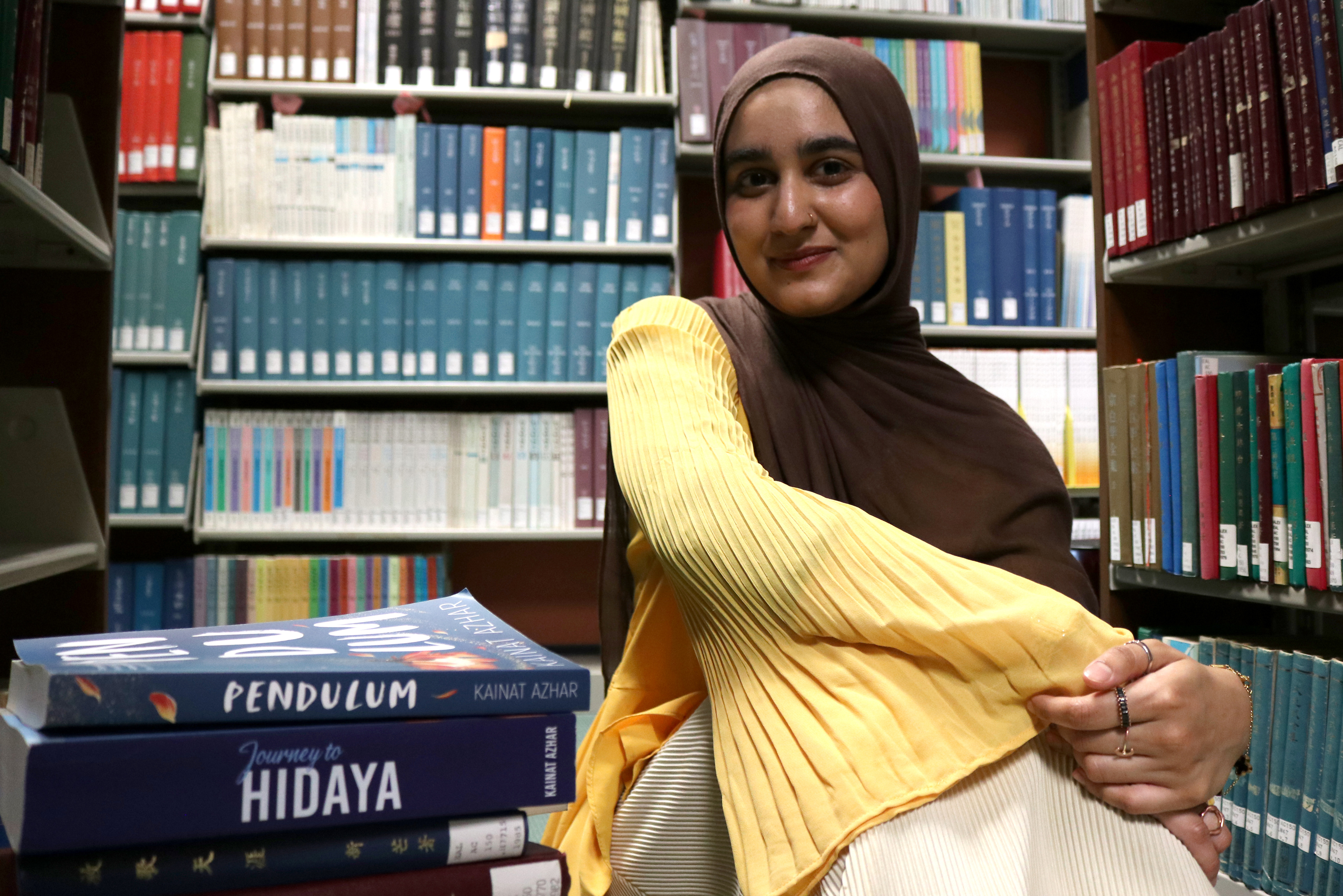
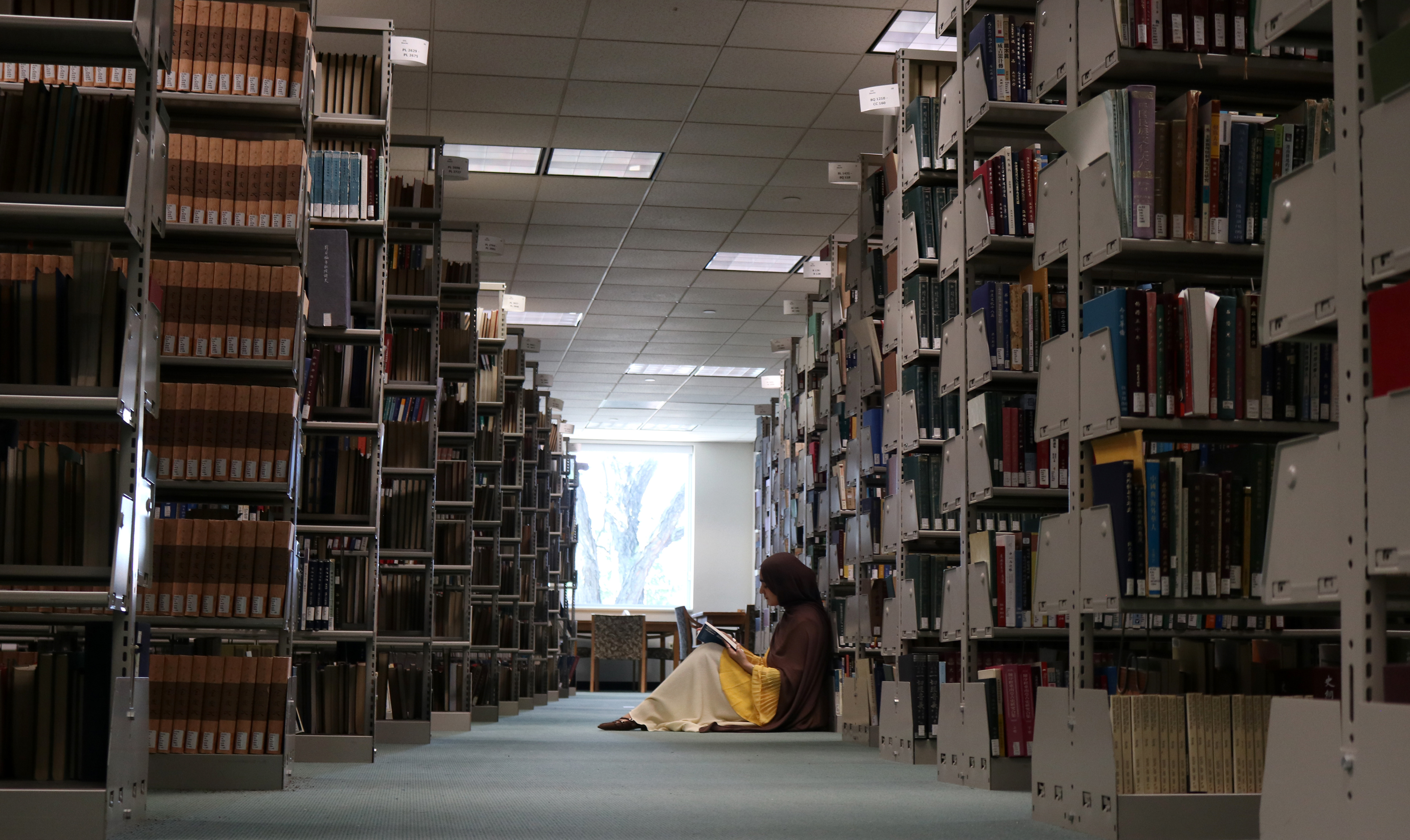
Kainat Azhar poses for the camera in Archibald S. Alexander Library at Rutgers University. (Photo by Sunah Choudhry)
A chance encounter with the Urdu novel “Pir-e-Kamil” changed the career trajectory of Pakistani Muslim author Kainat Azhar, who went from typing her stories on Wattpad in her room to seeing her first self-published halal romance novel on digital bookshelves across the internet. Though the journey proved to be filled with countless cold emails and relentless rejections, she pushed away thoughts of giving up and persevered to join the growing genre filling TikTok feeds.
There’s a romance novel for everyone on the shelf, and Azhar proves it with “Pendulum” and “Journey to Hidaya.” Penning both novels from personal experience, Azhar crafts halal romances that balance deeper themes such as love, grief, faith, and mental health through an Islamic lens. She builds tension, longing, and wanting within her characters in ways Muslim readers can enjoy — whether that means the slightest brush of hands, a racing heartbeat, or a subtle glance that unknowingly connects two characters for a lifelong journey of romance.
From #BookTok to bookstores, halal romances have fluttered into a full-out genre for young Muslims. It all started with a book, as Azhar explained in this interview with Central Desi.
Her responses have been edited and condensed.
How do you define halal stories, and when did you discover the genre?
Kainat: For me, coming into this genre of halal romance, I wanted to discover and write stories where physicality is not the main point of tension and the focus is more on emotional connection, restraint and holding yourself back. We need authentic stories with cultural and faith representation, sort of like an alternative to mainstream stories. We can still have all the enjoyable tropes from contemporary romance but with a Muslim spin on it.
I never saw people who looked like me in fiction growing up. I think my first encounter with the halal romance genre is the Urdu novel, “Pir-e-Kamil” (The Perfect Mentor) by Umera Ahmed. The book itself is an amazing, life-changing story. I can't even recall a single instance where the characters held hands until the very end of the book. I was like, “Oh my gosh, you can show romantic tension so well without necessarily the more explicit stuff.” It really prompted me to publish.
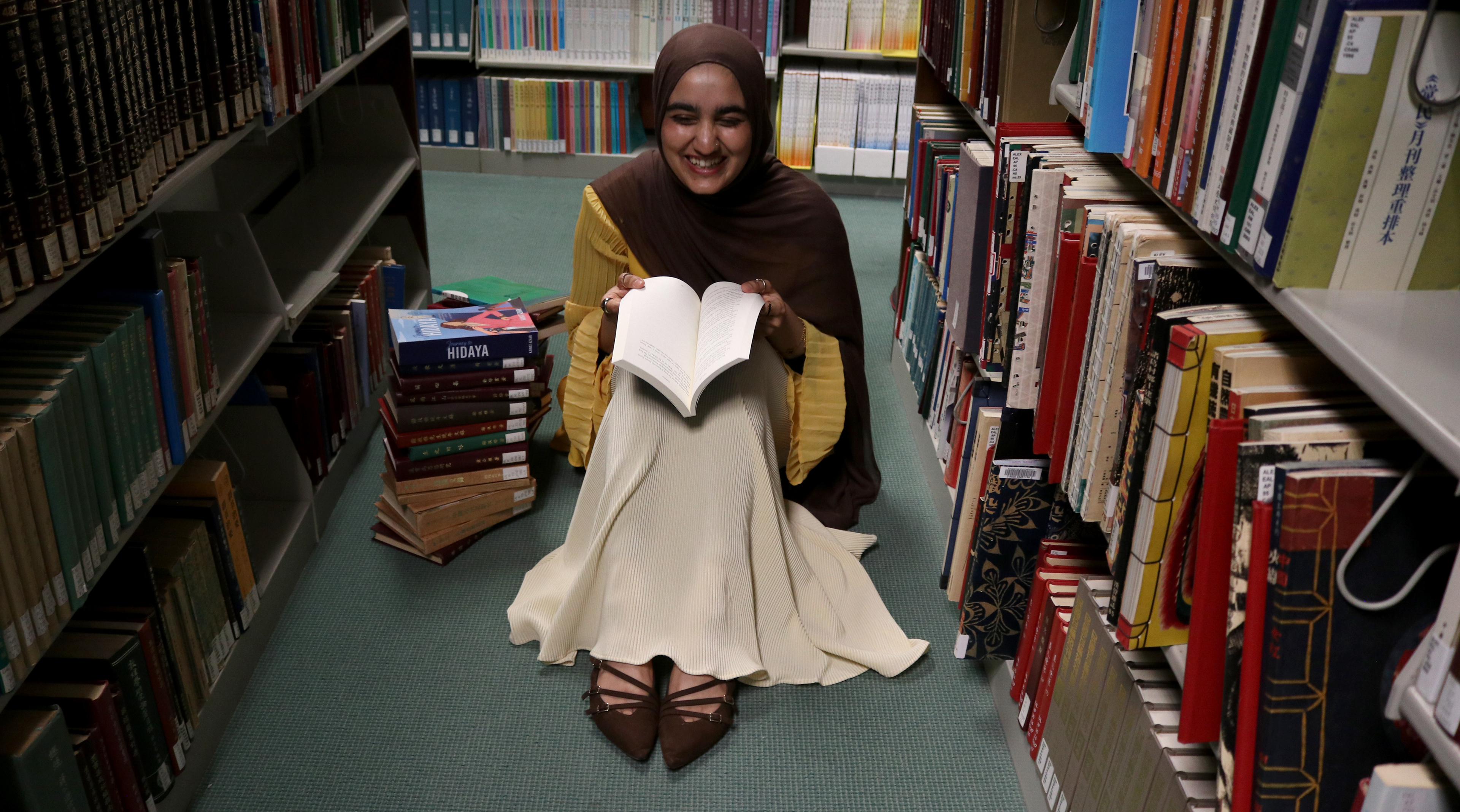
Azhar laughs while holding her self-published book, Pendulum. (Photo by Sunah Choudhry)
How do you handle displaying romance with modesty?
Kainat: There are definitely boundaries that I wouldn't intend to cross unless they serve a purpose in the story. In my first book, the main character, Zoya, is very loud and flirty, and she's very intentionally not thinking as she crosses the male main character's boundaries. That serves a purpose to her character because she has come out of a really abusive relationship, which leads her to view all men in a different light. She expresses this throughout the narrative and her character’s development.
All boundaries are tested by the character; again, that serves a purpose in the story. There are certain things I wouldn't ever want my characters to intentionally cross, physically and emotionally. We think of hand-holding and kissing, but we don't really think of emotional connection as a very real thing.
How do you reinvent classic tropes like workplace romances within an Islamic lens?
Kainat: Growing up reading all these other books in a Western context, I used to think that it would be very hard to write the classic [romance] tropes in a Muslim context. Now I find it much more enjoyable to do that. Because there's less focus on physical touch, I can focus on emotional tension and restraint. It forces a character and a reader to look beyond the physical. The focus in halal romance and in reinventing these tropes is on humor and sass, while maintaining Islamic values and boundaries to keep yourself and your character in check.
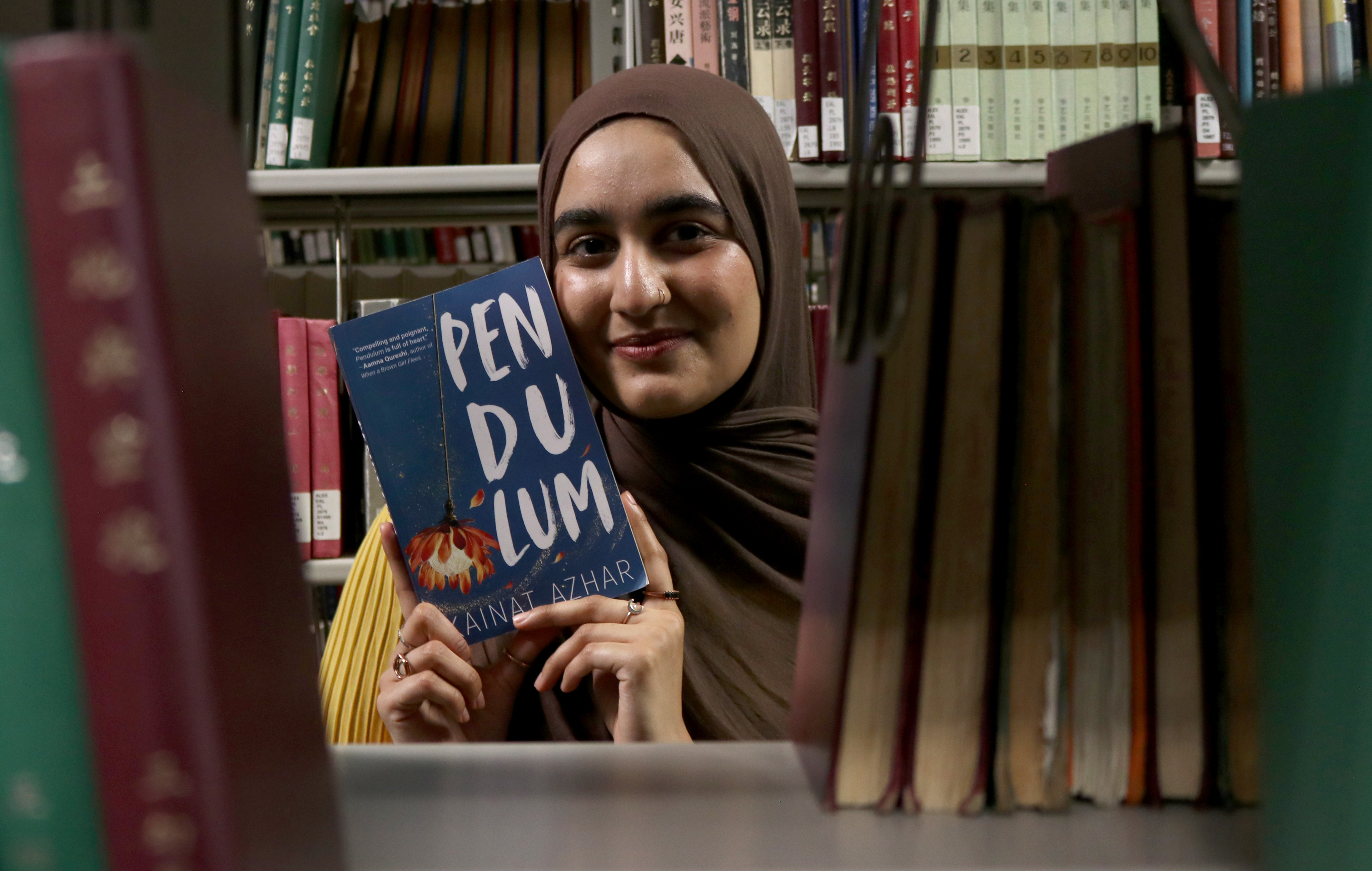
Azhar’s first book is a YA novel about finding oneself after grief shatters everything. (Photo by Sunah Choudhry)
What was it like writing from Hayat’s perspective in “Pendulum,” and did you pull from personal experience?
Kainat: Hayat was a surprisingly easy character to write. The words just flowed from one chapter into the next. In the acknowledgments section, I describe what character traits I pulled from each of my siblings.
The family dynamic is very similar to mine, and Hayat has a lot of my habits and thought processes. I think every author puts a little bit of themselves in their characters.
Hayat is young but emotionally mature and grounded. You see flashbacks of her before her brother died and then after he died, and it's two different people, which she talks about in her internal monologue and in the narrative.
Hayat becomes the glue holding her family together as everyone grieves her brother’s death. As a brown daughter, a lot of times when I'm talking about this book on Instagram or marketing it, people are like, “Oh, Hayat gives eldest daughter energy,” because much of Hayat’s experiences in the book are just the canon brown daughter experience.
How does faith play out in your books?
Kainat: In my first book, faith is a lot louder. It's the point of conflict for the main character. The whole book is her struggle with reconnecting with her faith. I hope to show through my work that everyone can struggle with faith differently and may reconnect with it differently. There's no cookie-cutter path. I hope readers can see the various stages of the journey and feel connected to it at some point.
I grew up attending an Islamic school from pre-K to eighth grade. We were taught to fear rather than build an actual loving connection with our faith. Ironically, I realized this after leaving Islamic school. Going into a public school, encountering such a large group of non-Muslims for perhaps the first time in my life, and being able to understand my faith on my own terms, led me to become the first person in my family to wear a hijab. In my work, I believe it's important to see characters as flawed first and to see them face challenges with their faith before they're able to admire it. Looking back on it now, I see that many Islamic schools have definitely improved in this regard.
Mental health is a widely discussed theme in your novels. How was it writing a character who struggled with mental health in “Pendulum?”
Kainat: I think mental health is consistent across all my works, both published and in progress. This is, unfortunately, another one of those things that's often brushed under the rug in South Asian communities. One thing that really bothers me is that it's attributed to not being faithful enough, so it's “You just need to pray more or make more dua.” Of course, those are very important tenets of our faith, but if you think about it, even the Prophet Muhammad, who was a prime example of a faithful man, still experienced extreme sadness and grief at different moments in his life. All of these heavier emotions, often thought of as negative, are very real parts of being human and important to experience.
Speaking of grief, how did it shape how you wrote “Pendulum?”
Kainat: My grandfather had a very significant impact on my life, and a lot of the grief behaviors and habits in Pendulum were drawn from the period he passed away. He was really excited to read my first book, but unfortunately he passed away before he could. The dedication at the front is to him. I was 19 at the time, so very close to Hayat's age. A lot of that period of my life parallels stuff in “Pendulum.” It was a coping mechanism. Aside from the grief of someone passing away, what cemented my desire to publish “Pendulum” was that writing it was healing me, and I wanted to share that with others.